
Table of Contents
ToggleWhy Your Website Isn’t Getting Website Traffic (And How to Fix It)
Tips to increase website traffic in 2026
If you’ve been publishing content, designing beautiful pages, and still struggling to get visitors, you’re not alone. Many website owners face the frustrating reality of low traffic, despite putting in hours of effort. The truth is, getting traffic today requires more than just posting content—it requires strategy, optimization, and consistent promotion.
In this article, we will break down why your website isn’t attracting traffic and show you exactly Tips to increase website traffic in 2026 with actionable steps, real examples, and expert tips. By the end, you’ll have a roadmap to grow both organic and referral traffic for your site.
In this guide, we’ll explore the real reasons your site isn’t getting website traffic, and more importantly, how to fix it step by step. By the end, you’ll understand what’s blocking your traffic growth and have a clear action plan to grow organic search visitors, social visitors, and returning users.
Let’s dive in.
🔎 What Is Website Traffic and Why It Matters
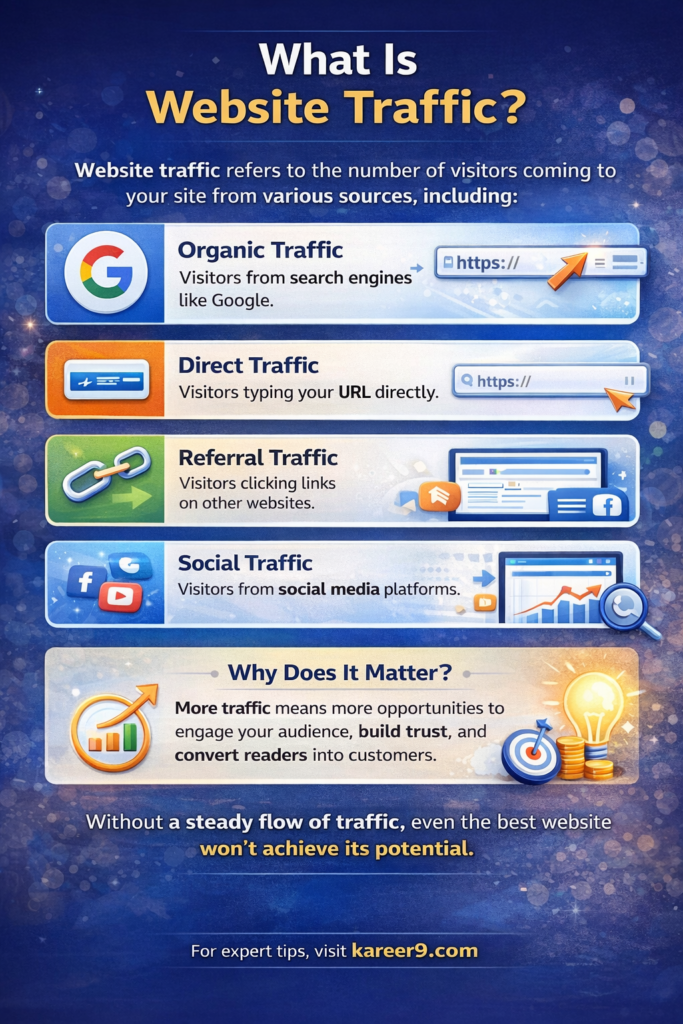
Before we jump into strategies, let’s clarify what website traffic actually is. Website traffic refers to the number of visitors coming to your site from various sources, including:
Organic traffic – Visitors from search engines like Google.
Direct traffic – Visitors typing your URL directly.
Referral traffic – Visitors clicking links on other websites.
Social traffic – Visitors from social media platforms.
Why does this matter? Because more traffic means more opportunities to engage your audience, build trust, and convert readers into customers. Without a steady flow of traffic, even the best website won’t achieve its potential. To increase traffic, read this blog “Tips to increase website traffic in 2026“.
Understanding the Importance of Consistent Traffic Growth
Why Traffic Growth Matters
Building a successful website is not just about publishing content; it’s also about making sure people actually find it. Many website owners spend hours creating blog posts but still struggle to attract visitors. That is why learning practical tips to increase website traffic in 2026 is extremely important. When your website receives consistent visitors, your content has a better chance of being discovered, shared, and recommended by readers who find it valuable.
Search Engines Love Active Websites
Another important factor to consider is how search engines evaluate your website. When users regularly visit your pages and spend time reading your content, search engines recognize that your website provides useful information. As a result, your pages may rank higher in search results. Following proven tips to increase website traffic in 2026 can help improve your website’s visibility and strengthen your SEO performance over time.
More Visitors Means More Opportunities
When your website attracts more visitors, it opens the door to many new opportunities. For example, readers may subscribe to your newsletter, explore your services, or share your content with others. Businesses and bloggers who follow effective tips to increase website traffic in 2026 often experience stronger engagement, better brand awareness, and improved conversions.
Long-Term Website Growth
Finally, it’s important to remember that growing a website takes time and consistent effort. Traffic rarely increases overnight, but with the right strategy and persistence, results will appear. By applying practical tips to increase website traffic in 2026, you can steadily build your audience and create long-term success for your website.
📉 Common Reasons Your Website Isn’t Getting Website Traffic
Many websites fail to attract visitors because of predictable, fixable mistakes. Understanding these barriers is the first step to growth. (Read post “Tips to increase website traffic” to avoid this)
1. Poor Search Engine Optimization (SEO)
One of the top reasons for low traffic is weak SEO. Without proper keyword usage, meta tags, and structured content, search engines won’t rank your site, no matter how great it looks.
🔹 How Search Engines Work
Search engines crawl and index websites using complex algorithms. If your site lacks keywords, meta tags, descriptive titles, and proper structure, it simply won’t rank well.
Example issue:
A post titled “Top Tips for Blogging” might be too vague, while a better title like “Tips to increase website traffic in 2026” includes a keyword and search intent.
✔ Fix Your SEO
Conduct keyword research using tools like Google Keyword Planner or SEMrush.
Use the main keyword (“website traffic”) in your title, headings, URL, and meta description.
Structure your content with subheadings (H2, H3, H4).
Include internal links to related posts (e.g.,
[YourSite.com/seo‑checklist]).Add descriptive alt text to images.
👉 Start with your latest posts and optimize them first—it often boosts traffic faster than creating new content. (Read the post “Tips to increase website traffic in 2026”).
2. Content Doesn’t Match User Intent
Even if your website ranks on Google, traffic will remain low if your content doesn’t satisfy user intent. Users search for solutions, not vague ideas.
How to fix it:
Identify the question or problem your audience is trying to solve.
Align your content with that goal.
Include step-by-step instructions, examples, and visuals.
For example, if someone searches “tips to increase website traffic in 2026”, they expect actionable strategies, not generic advice.
3. Low-Quality Content
If your content is shallow, repetitive, or hard to read, visitors won’t stay. Google also favors high-quality, informative content, so low-quality posts hurt your rankings and reduce traffic.
How to improve quality: (Read the blog “Tips to increase website traffic”)
Write long-form content (1,500–2,500 words) with clear sections.
Add visuals, charts, and examples to make the content engaging.
Use transition words like “however,” “moreover,” and “for instance” to create flow.
Break text into short paragraphs for readability.
4. Slow Page Speed and Poor User Experience
A slow-loading site drives users away before they even read your content. Similarly, confusing navigation or non-mobile-friendly design can reduce traffic.
Solutions:
Compress images using tools like TinyPNG.
Use a fast hosting provider.
Minimize unnecessary plugins and scripts.
Ensure your site is mobile-responsive.
💡 Fun fact: Studies show that if a page takes more than 3 seconds to load, over half of users leave immediately. (Read the blog “Tips to increase the website traffic in 2026”)
5. Lack of Promotion
Great content alone isn’t enough. Even with perfect SEO, you need Tips to increase website traffic in 2026.
Ways to promote your content:
Share posts on social media platforms like Facebook, LinkedIn, Twitter, and Instagram.
Build and email your newsletter list.
Collaborate with other bloggers or websites through guest posts and backlinks.
Engage in communities and forums related to your niche.
For instance, sites like kareer9.com show how strategic promotion improves reach and establishes authority.
Steps to Increase Website Traffic in 2026: Step-by-Step
Now that we understand the problems, here’s how to actively grow your traffic. (By reading the post “Tips to increase website traffic”)
Step 1 –
Conduct Keyword Research
Keyword research forms the foundation of any traffic growth strategy. Focus on long-tail keywords like “steps to increase website traffic in 2026” to target specific search intent.
Actionable tips:
Use Google Keyword Planner or SEMrush to identify keywords with good volume and low competition.
Map keywords to your content structure, using H2s and H3s for subtopics.
Include keywords naturally in text, headings, and images.
Step 2 –
Optimize
On-Page SEO
On-page SEO ensures Google understands your content.
Include keywords in title, URL, meta description, headings, and alt text.
Use schema markup for articles, FAQs, and products.
Create internal links to other pages on your site.
This strategy directly contributes to higher rankings and consistent traffic.
Step 3 –
Write Engaging,
High-Quality Content
Content is still king, especially for long-term website traffic growth.
Aim for 1,500–2,500 words with actionable advice.
Use headings, bullet points, and images to enhance readability.
Add examples, case studies, and visuals wherever possible.
💡 Tip: Humanized, conversational tone helps retain readers and encourages sharing.
Step 4 – Improve User Experience
Your visitors should enjoy their stay:
Optimize page speed.
Ensure mobile responsiveness.
Use intuitive navigation menus.
Include CTA buttons to guide visitors (e.g., newsletter signup).
A smooth experience increases time on site, reducing bounce rates and signaling quality to Google.
Step 5 – Build Backlinks and Authority
Backlinks from credible sites improve search rankings and drive referral traffic.
How to get backlinks:
Guest posting on reputable blogs.
Reaching out for broken link replacements.
Collaborating with niche influencers.
Linking to authority sites like kareer9.com.
Step 6 – Leverage Social Media and Email Marketing
Share content across multiple platforms.
Repurpose blog posts into social media snippets.
Build an email list and send updates whenever you publish new content.
These channels bring immediate traffic boosts and repeat visits.
Step 7 – Track, Analyze, and Improve
Use analytics tools to monitor performance:
Google Analytics: Track top pages, sources, and bounce rates.
Google Search Console: Identify queries that bring traffic.
Hotjar: Understand user behavior on your site.
Use these insights to tweak content, optimize underperforming pages, and continuously improve your traffic strategy. (Read “Tips to increase website traffic”)
FAQs About Website Traffic
How long will it take to increase website traffic in 2026?
It depends on consistency, quality, and promotion. Most websites see noticeable results within 3–6 months of applying these strategies. (For more information read the post “Tips to increase website traffic”)
Can social media replace SEO?
No. Social media drives short-term bursts of traffic, while SEO builds long-term, sustainable traffic.
How often should I publish content?
Focus on quality over quantity. Posting 1–2 high-quality articles per week is better than daily low-value content. (For more details read “Tips to increase website traffic”)
Can new websites get traffic quickly?
Yes, even new websites can start attracting visitors if you apply the right strategies. Using tips to increase website traffic in 2026, such as targeted keyword optimization, consistent content publishing, and active promotion on social media, can help a new site gain traction faster.
Should I focus more on SEO or social media for traffic?
Both are important, but SEO builds long-term, sustainable traffic, while social media often provides short-term boosts. By following the tips to increase website traffic in 2026, you can balance both approaches: optimize your content for search engines while also promoting it on social platforms to maximize visibility and engagement.
Key Takeaways
Focus on on-page and off-page SEO.
Create content that matches user intent and solves real problems.
Promote content via social media, email, and partnerships.
Optimize for speed, UX, and mobile-friendliness.
Use analytics to track progress and improve continuously.
By following these steps, you’ll not only see a steady increase in traffic but also attract high-quality visitors who engage with your content. (Read the post “Tips to increase website traffic”)
Related Articles
For more tips on traffic growth and digital marketing strategies, visit kareer9.com.
Conclusion
Increasing your website’s visitors requires more than just posting content—it takes a strategic approach, consistent effort, and smart promotion. By following the proven tips to increase the website traffic in 2026, you can improve your search rankings, attract the right audience, and build long-term engagement.
Remember, implementing these tips to increase the website traffic in 2026 is not a one-time task. Regularly updating content, optimizing for SEO, and promoting your site through multiple channels will ensure that your traffic continues to grow steadily.
Finally, focus on the actionable tips to increase the website traffic in 2026 outlined in this guide. By applying them consistently, you can transform your website into a highly visible, trusted resource that drives engagement, leads, and conversions for years to come.